I could give you the statistics of domestic violence today, but I wanted to have you think for a moment with your heart. Imagine feeling like you have no one to turn to or will understand that you love your abuser and want them to get help so it gets better. You've fooled yourself into believing that if you don't do anything wrong they'll be good. You believe your kids need both parents and besides you don't have money or family to turn to since everyone had to be alienated. You hide the bruises with long sleeves and put on your best smile to cover the worst pain of all - the WORDS that are forever stuck in your mind and heart. The names you are called daily and the feeling of worthlessness. No one will ever want you and you will never leave me. You can't leave when you don't have somewhere to go and you've been told repeatedly that they will kill you if you try. The laws aren't strong enough to keep the abuser in jail and keep you safe from more harm. Most domestic violence cases are misdemeanors which is a travesty of justice since most often times the victim is so badly beat up that the abuser should go away for years not hours. When you ask for an injunction and the judge gives it to you - it's just a piece of paper that says the abuser cannot be within 500 feet of you. The police have their hands tied without a proper law that allows them to actually do something like take them to jail whether you want them to or not. They can put them in a batterer's intervention class that will do nothing, but allow them time to hang out with other abusers and text their friends. It's a crying shame how someone can cause so much pain and not get in trouble for it. Leaving most of the time is just not an option.
Furthermore when you get away from your abuser penniless and been out of work for a long time you have to figure it out immediately. The thoughts that go through your mind are I've got to find a job so I can show I can take care of my child and don't lose custody. Once again, control again and fear again. It's all a game they play.
If you ever find yourself wondering why a victim of domestic violence doesn't leave, maybe just maybe I have shed some light on the reasons why. Please protect your family from this ever growing epidemic, it's an all consuming disease of everyone around. It's a vicious circle and by bringing awareness to the problems with laws and the lack of help someone can be saved. I appreciate each and every one of you that read my blog and truly pray that it helps at least one person. Take care. God Bless
Wednesday, September 26, 2012
Wednesday, September 19, 2012
Please tell me why
Why are so many people afraid to stand up for a cause that protects victims of domestic violence? Children are affected every day and still no one wants to get involved??
If you don't stand for something, you'll fall for anything! How would you feel if your loved one was the victim would it matter then? There are so many ways to help and still no one makes the call. I sleep well at night knowing I am working towards a better world and I have big plans for domestic violence awareness. What are your goals, what do you want to see change? It's a crying shame that the statistics of DV are going up each day and yet I do this pretty much alone. God bless the wonderful shelters that take these victims in and show them how to move on with their lives. It's still not enough and unless our community gets involved too then it's just a group of us silently helping. Did you know by you not being involved you are allowing more abusers to get away with their crime, you are enabling them. Please get involved, do your part today!!
Tuesday, September 18, 2012
Myths of DV
MYTH #1: THE REAL PROBLEM IS COUPLES WHO ASSAULT EACH OTHER. WOMEN ARE JUST AS VIOLENT AS MEN.
FACT: A well-publicized study conducted by Dr. Murray Strauss at the University of New Hampshire found that women use violent means to resolve conflict in relationships as often as men. However, the study also concluded that when the context and consequences of an assault are measured, the majority of victims are women. The U.S. Department of Justice has found that 85% of the victims of spouse abuse are female. Men can be victims, but it is rare.
MYTH #2: ALCOHOL ABUSE CAUSES DOMESTIC VIOLENCE.
FACT: Although there is a high correlation between alcohol, or other substance abuse, and battering, it is not a causal relationship. Batterers use drinking as one of many excuses for their violence and as a way to place the responsibility for their violence elsewhere. Stopping the abusers' drinking will not stop the violence. Both battering and substance abuse need to be addressed separately, as overlapping yet independent problems.
MYTH #3: DOMESTIC VIOLENCE IS USUALLY A ONE TIME, ISOLATED OCCURRENCE.
FACT: Battering is a pattern of coercion and control that one person exerts over another. Battering is not just one physical attack. It includes the repeated use of a number of tactics, including intimidation, threats, economic deprivation, isolation and psychological and sexual abuse. Physical violence is just one of these tactics. The various forms of abuse utilized by batterers help to maintain power and control over their spouses and partners.
MYTH #4: MEN WHO BATTER ARE OFTEN GOOD FATHERS AND SHOULD HAVE JOINT CUSTODY OF THEIR CHILDREN IF THE COUPLE SEPARATES.
Fact: Studies have found that men who batter their wives also abuse their children in 70% of cases. Even when children are not directly abused, they suffer as a result of witnessing one parent assault another. Batterers often display an increased interest in their children at the time of separation, as a means of maintaining contact with, and thus control over, their partners.
MYTH #5: WHEN THERE IS VIOLENCE IN THE FAMILY, ALL MEMBERS OF THE FAMILY ARE PARTICIPATING IN THE DYNAMIC, AND THEREFORE, ALL MUST CHANGE FOR THE VIOLENCE TO STOP.
FACT: Only the batterer has the ability to stop the violence. Battering is a behavioral choice for which the batterer must be held accountable. Many battered women make numerous attempts to change their behavior in the hope that this will stop the abuse. This does not work. Changes in family members' behavior will not cause the batterer to be non-violent.
MYTH #6: BATTERED WOMEN ARE MASOCHISTIC AND PROVOKE THE ABUSE. THEY MUST LIKE IT OR THEY WOULD LEAVE.
FACT: Victim provocation is no more common in domestic violence than in any other crime. Battered women often make repeated attempts to leave violent relationships, but are prevented from doing so by increased violence and control tactics on the part of the abuser. Other factors which inhibit a victim's ability to leave include economic dependence, few viable options for housing and support, unhelpful responses from the criminal justice system or other agencies, social isolation, cultural or religious constraints, a commitment to the abuser and the relationship and fear of further violence. It has been estimated that the danger to a victim increases by 70% when she attempts to leave, as the abuser escalates his use of violence when he begins to lose control.
MYTH #7: MEN HAVE A RIGHT TO DISCIPLINE THEIR PARTNERS FOR MISBEHAVING. BATTERING IS NOT A CRIME.
FACT: While our society derives from a patriarchal legal system that afforded men the right to physically chastise their wives and children, we do not live under such a system now. Women and children are no longer considered the property of men, and domestic violence is a crime in every state In the country.
http://www.clarkprosecutor.org/html/domviol/myths.htm
FACT: A well-publicized study conducted by Dr. Murray Strauss at the University of New Hampshire found that women use violent means to resolve conflict in relationships as often as men. However, the study also concluded that when the context and consequences of an assault are measured, the majority of victims are women. The U.S. Department of Justice has found that 85% of the victims of spouse abuse are female. Men can be victims, but it is rare.
MYTH #2: ALCOHOL ABUSE CAUSES DOMESTIC VIOLENCE.
FACT: Although there is a high correlation between alcohol, or other substance abuse, and battering, it is not a causal relationship. Batterers use drinking as one of many excuses for their violence and as a way to place the responsibility for their violence elsewhere. Stopping the abusers' drinking will not stop the violence. Both battering and substance abuse need to be addressed separately, as overlapping yet independent problems.
MYTH #3: DOMESTIC VIOLENCE IS USUALLY A ONE TIME, ISOLATED OCCURRENCE.
FACT: Battering is a pattern of coercion and control that one person exerts over another. Battering is not just one physical attack. It includes the repeated use of a number of tactics, including intimidation, threats, economic deprivation, isolation and psychological and sexual abuse. Physical violence is just one of these tactics. The various forms of abuse utilized by batterers help to maintain power and control over their spouses and partners.
MYTH #4: MEN WHO BATTER ARE OFTEN GOOD FATHERS AND SHOULD HAVE JOINT CUSTODY OF THEIR CHILDREN IF THE COUPLE SEPARATES.
Fact: Studies have found that men who batter their wives also abuse their children in 70% of cases. Even when children are not directly abused, they suffer as a result of witnessing one parent assault another. Batterers often display an increased interest in their children at the time of separation, as a means of maintaining contact with, and thus control over, their partners.
MYTH #5: WHEN THERE IS VIOLENCE IN THE FAMILY, ALL MEMBERS OF THE FAMILY ARE PARTICIPATING IN THE DYNAMIC, AND THEREFORE, ALL MUST CHANGE FOR THE VIOLENCE TO STOP.
FACT: Only the batterer has the ability to stop the violence. Battering is a behavioral choice for which the batterer must be held accountable. Many battered women make numerous attempts to change their behavior in the hope that this will stop the abuse. This does not work. Changes in family members' behavior will not cause the batterer to be non-violent.
MYTH #6: BATTERED WOMEN ARE MASOCHISTIC AND PROVOKE THE ABUSE. THEY MUST LIKE IT OR THEY WOULD LEAVE.
FACT: Victim provocation is no more common in domestic violence than in any other crime. Battered women often make repeated attempts to leave violent relationships, but are prevented from doing so by increased violence and control tactics on the part of the abuser. Other factors which inhibit a victim's ability to leave include economic dependence, few viable options for housing and support, unhelpful responses from the criminal justice system or other agencies, social isolation, cultural or religious constraints, a commitment to the abuser and the relationship and fear of further violence. It has been estimated that the danger to a victim increases by 70% when she attempts to leave, as the abuser escalates his use of violence when he begins to lose control.
MYTH #7: MEN HAVE A RIGHT TO DISCIPLINE THEIR PARTNERS FOR MISBEHAVING. BATTERING IS NOT A CRIME.
FACT: While our society derives from a patriarchal legal system that afforded men the right to physically chastise their wives and children, we do not live under such a system now. Women and children are no longer considered the property of men, and domestic violence is a crime in every state In the country.
http://www.clarkprosecutor.org/html/domviol/myths.htm
Thursday, September 13, 2012
A big shout out!
HUSH PUPPY HAVEN
is an amazing group of people working to protect your beloved pet while you are trying to get out of your domestic violence situation. I praise them for all the work they do and just wanted to say thank you to them!!! Please check out their website and facebook page and show your support!!!!!
Wednesday, September 12, 2012
The Facts~
One in four women (25%) has experienced domestic violence in her lifetime.
(The Centers for Disease Control and Prevention and The National Institute of Justice, Extent, Nature, and Consequences of Intimate Partner Violence, July 2000. The Commonwealth Fund, Health Concerns Across a Woman’s Lifespan: 1998 Survey of Women’s Health, 1999)
On average, more than three women and one man are murdered by their intimate partners in this country every day. In 2000, 1,247 women were killed by an intimate partner. The same year, 440 men were killed by an intimate partner. Intimate partner homicides accounted for 30% of the murders of women and 5% percent of the murders of men.
(Bureau of Justice Statistics Crime Data Brief, Intimate Partner Violence, 1993-2001, February 2003. Bureau of Justice Statistics, Intimate Partner Violence in the U.S. 1993-2004, 2006.)
Most intimate partner homicides occur between spouses, though boyfriends/girlfriends have committed about the same number of homicides in recent years.
(Bureau of Justice Statistics, Intimate Partner Violence in the U.S. 1993-2004, 2006.)
http://www.dvrc-or.org/domestic/violence/resources/C61/
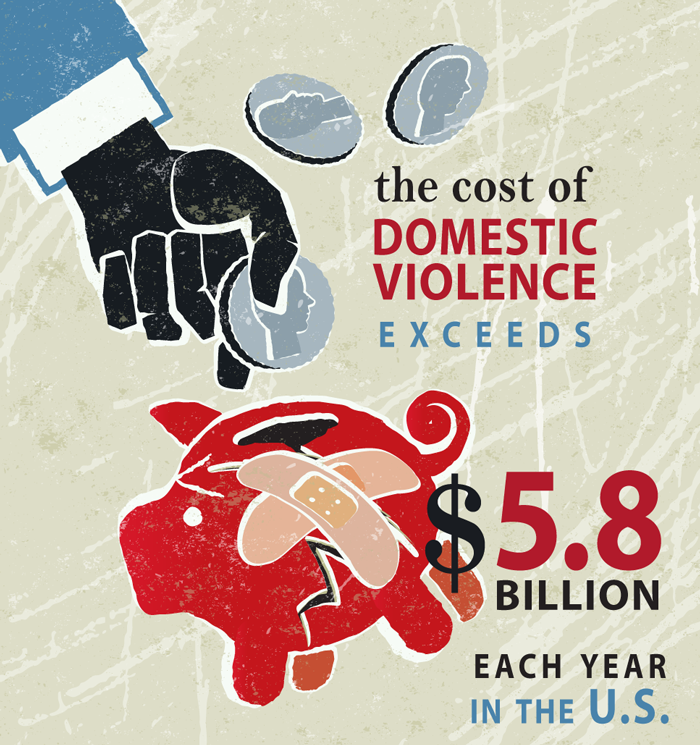
The costs of intimate partner rape, physical assault, and stalking exceed $5.8 billion each
year, nearly $4.1 billion of which is for direct medical and mental health care services.
The total costs of IPV also include nearly $0.9 billion in lost productivity from paid work
and household chores for victims of nonfatal IPV and $0.9 billion in lifetime earnings
lost by victims of IPV homicide. The largest proportion of the costs is derived from
physical assault victimization because that type of IPV is the most prevalent. The largest
component of IPV-related costs is health care, which accounts for more than two-thirds of
the total costs.
Violence against women is a substantial public health problem in the United States.
According to data from the criminal justice system, hospital and medical records, mental
health records, social services, and surveys, thousands of women are injured or killed
each year as a result of violence, many by someone they are involved with or were
involved with intimately. Nearly one-third of female homicide victims reported in police
records are killed by an intimate partner (Federal Bureau of Investigation 2001).
Intimate partner violence—or IPV— is violence committed by a spouse,
ex-spouse, or current or former boyfriend or girlfriend. It occurs among both heterosexual and same-sex couples and is often a repeated offense. Both men and women are victims of IPV, but the literature indicates that women are much more likely than men to suffer physical, and probably psychological, injuries from IPV (Brush 1990; Gelles 1997; Rand and Strom 1997; Rennison and Welchans 2000).
IPV results in physical injury, psychological trauma, and sometimes death (Gelles 1997;
Kernic, Wolf and Holt 2000; Rennison and Welchans 2000; Sorenson and Saftlas 1994).
The consequences of IPV can last a lifetime. Abused women experience more physical
health problems and have a higher occurrence of depression, drug and alcohol abuse,
and suicide attempts than do women who are not abused (Golding 1996; Campbell,
Sullivan and Davidson 1995; Kessler et al. 1994; Kaslow et al. 1998; Moscicki 1989).
They also use health care services more often (Miller, Cohen and Rossman 1993).
A growing body of evidence demonstrates the health consequences of intimate partner
violence against women (Coker, Smith, Bethea, King and McKeown 2000; Kernic,
Wolf and Holt 2000). However, the economic costs of IPV remain largely unknown.
Previous cost estimates range from $1.7 billion to $10 billion annually (Straus 1986;
Gelles and Straus 1990; Meyer 1992), but they are believed to underestimate the true
economic impact of this type of violence (Institute for Women’s Policy Research 1995).
There was so much to show you so I have made sure to include the link as well as the title information so that you may read it all yourself. This is just one of thousands of reports, it's staggering how much this affects our health care. Something has to change don't you think?
This was taken from:
Costs of Intimate Partner Violence
Against Women in the United States
Department of Health and Human Services
Centers for Disease Control and Prevention
National Center for Injury Prevention and Control
http://www.cdc.gov/ncipc/pub-res/ipv_cost/ipvbook-final-feb18.pdf
Tuesday, September 11, 2012
A day of remembrance
I woke up this morning realizing all too painfully that today is September 11th. I want to say to all the families and friends that lost their loved ones that fateful day that I am saying prayers for all of you. That day will always be in our minds as well as our hearts and should never be forgotten.
God Bless our soldiers who fight every day for our freedom and may never come home. I pray for a world with peace and I know that sounds idealistic, but wouldn't it be nice if people came together instead of divide. I also want to say prayers for the victims of domestic violence that have died utterly merciless and their families who are left behind to pick up the pieces. Like September 11th domestic violence is like war and we must put an end to this ever growing epidemic!!
Prayers to all. Much love!! Educate before it's too late!!!
God Bless our soldiers who fight every day for our freedom and may never come home. I pray for a world with peace and I know that sounds idealistic, but wouldn't it be nice if people came together instead of divide. I also want to say prayers for the victims of domestic violence that have died utterly merciless and their families who are left behind to pick up the pieces. Like September 11th domestic violence is like war and we must put an end to this ever growing epidemic!!
Prayers to all. Much love!! Educate before it's too late!!!
Monday, September 10, 2012
The phases of abuse
Victims what phase are you in?
I feel the honeymoon phase is just as scary, because you don't know when it will end.
Subscribe to:
Posts (Atom)